
Severe thunderstorms battered New Jersey on Thursday, August 20, bringing torrential rain, flash flooding, power outages and dangerous conditions to roads across the state.
The impact was widespread. NorthJersey.com reported that some New Jersey communities received approximately two inches or more of rain, including 2.17 inches in Sparta and 1.82 inches in Ramsey. The publication also reported flooding and lane closures affecting major North Jersey roads, including Route 17, Route 3, Route 21 and the Garden State Parkway.
The situation became particularly dangerous for motorists. According to an Associated Press report on the severe Northeast storms, Jersey City emergency responders rescued 69 people trapped in flooded vehicles, using inflatable rafts to reach stranded motorists.
These incidents illustrate something New Jersey drivers can encounter with very little warning: severe weather can transform an ordinary commute into a serious accident risk.
Floodwater is only one hazard. Heavy rain can reduce visibility and traction. Standing water can cause vehicles to hydroplane. High winds can affect passenger vehicles and commercial trucks. Fallen trees and debris can obstruct roadways. Flooded intersections may conceal hazards, while pedestrians and bicyclists can become significantly harder for drivers to see.
Those conditions can contribute to hydroplaning crashes, rear-end collisions, multi-vehicle accidents, truck crashes, pedestrian accidents, bicycle accidents and other serious personal injuries.
But when an accident happens during a storm, an important legal question follows:
Did the Weather Cause the Accident—or Did Someone's Actions Contribute to It?
Bad weather does not automatically mean that no one is responsible for an accident.
For someone injured in a storm-related crash, determining whether there may be a personal injury claim in NJ can require examining what a driver, commercial vehicle operator, property owner or another potentially responsible party did—or failed to do—under the conditions that existed at the time.
If you were injured in a weather-related accident, Khorozian Law Group's New Jersey car accident lawyer can review what happened and help determine whether another party may be legally responsible. Call (201) 944-9200 to discuss your accident.
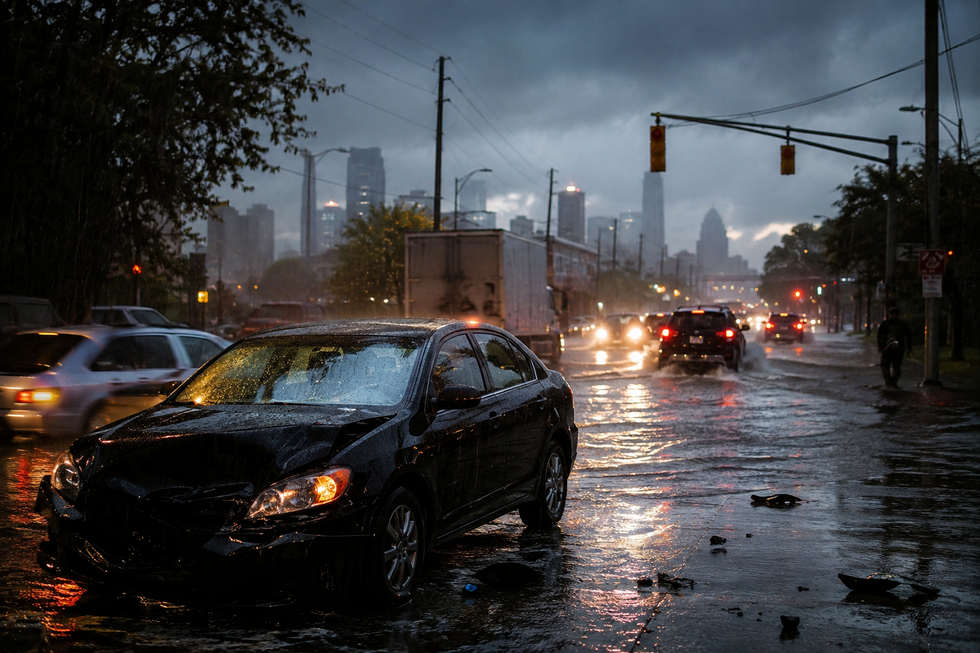
Severe Weather Can Cause More Than Flooding on New Jersey Roads
New Jersey drivers routinely encounter rain, snow, ice and high winds. But severe storms can create several hazards simultaneously.
A driver may be dealing with heavy rain while visibility drops, traffic suddenly slows and standing water develops across the roadway.
Weather-related accidents can include:
- Hydroplaning and loss-of-control accidents;
- Rear-end collisions;
- Multi-vehicle crashes;
- Sideswipe accidents;
- Intersection collisions;
- Truck and commercial vehicle accidents;
- Crashes involving fallen trees or roadway debris;
- Pedestrian accidents;
- Bicycle and e-bike accidents;
- Accidents involving vehicles stranded in floodwater; and
- Slip-and-fall and other premises-related injuries after a storm.
The fact that severe weather was present does not automatically answer who was responsible.
1. Hydroplaning and Loss-of-Control Car Accidents
Hydroplaning occurs when a vehicle's tires lose sufficient contact with the roadway because of water between the tires and pavement.
The New Jersey MVC Driver Manual's wet-road and hydroplaning guidance states that motorists should drive more slowly on wet roads and increase following distance. The manual also warns that hydroplaning can begin at approximately35 mph, with the risk increasing as speed increases.
That makes hydroplaning more than simply a weather phenomenon.
After a hydroplaning accident, important questions may include:
- How fast was the driver traveling?
- Was there visible standing water?
- Was the driver following another vehicle too closely?
- Were the vehicle's tires worn?
- Did the driver make an abrupt turn or lane change?
- Did the driver ignore deteriorating road conditions?
- Did the driver reduce speed when the rain became heavier?
A driver does not necessarily avoid responsibility simply by saying, “I hydroplaned.”
A car accident lawyer NJ may investigate whether the driver's behavior before losing control was reasonable given the weather and roadway conditions.
Can You Be at Fault for Hydroplaning in New Jersey?
Potentially.
Hydroplaning itself can occur quickly, but liability may depend heavily on what happened before the vehicle lost traction.
There can be an important difference between a motorist who substantially reduces speed after encountering standing water and one who continues driving too fast for the conditions despite heavy rain and visibly flooded pavement.
Evidence such as dashcam footage, surveillance video, witness statements, vehicle damage, tire condition and accident-scene photographs may become important when determining what caused the crash.
2. Rear-End Accidents on Wet Roads
Heavy rain can increase stopping distance and make sudden braking more difficult.
The New Jersey MVC specifically advises motorists to drive more slowly on wet roads and increase following distance.
That becomes particularly important during:
- Sudden traffic backups;
- Flash flooding;
- Highway congestion;
- Reduced visibility; and
- Emergency braking.
A driver who follows another vehicle too closely for the conditions may be unable to stop when traffic ahead suddenly slows.
Someone injured in this type of collision may want a car accident attorney NJ to investigate not only the weather, but also the other driver's speed, following distance and conduct immediately before impact.
3. Multi-Vehicle Accidents During Heavy Rain
One collision during severe weather can quickly become several.
A vehicle may hydroplane and strike another car. Traffic behind the initial collision may brake suddenly. Drivers with limited visibility may not see the stopped vehicles until it is too late.
The result can be a multi-vehicle accident involving several drivers and insurance companies.
Determining liability in these cases can be complicated because responsibility may not rest with only one driver.
Police reports, photographs, video, witness statements, vehicle damage and the sequence of impacts can become critical evidence.
An accident attorney NJ may need to determine which collision occurred first, what each driver was doing and whether more than one person's negligence contributed to the accident.
4. Truck Accidents During Heavy Rain and High Winds
Severe weather can present additional risks for tractor-trailers and other commercial vehicles.
Large trucks require additional space to maneuver and stop. Wet roads reduce traction, while strong winds can create additional risks for trailers and other high-profile commercial vehicles.
New Jersey's commercial driver guidance warns that wet roads can double stopping distance and advises commercial drivers to reduce speed on wet surfaces. It also identifies standing water as a potential hydroplaning hazard.
A weather-related commercial truck crash may therefore raise questions about:
- The truck driver's speed;
- Following distance;
- Tire condition;
- Vehicle maintenance;
- Cargo and vehicle stability;
- Whether the driver appropriately reduced speed; and
- Whether the vehicle was being operated appropriately for the conditions.
Our New Jersey truck accident lawyer page discusses additional evidence and potentially responsible parties that may be involved when a commercial vehicle causes a serious collision.
5. Flooded-Road and Stranded-Vehicle Accidents
Thursday's Jersey City rescues demonstrate how rapidly flash flooding can transform an ordinary street into a dangerous environment.
The National Weather Service's flood-driving safety guidance reports that more than half of flood-related drownings occur when vehicles are driven into hazardous floodwater. The NWS also warns that approximately 12 inches of rushing water can carry away most cars, while two feet of rushing water can carry away SUVs and trucks.
The National Weather Service's familiar warning is:
“Turn Around Don't Drown.”
Drivers are also warned not to drive around barricades because water can conceal a collapsed roadway or other hazards.
Flood-related accidents can involve much more than a vehicle simply becoming submerged.
A stranded vehicle may subsequently be struck by another driver. Vehicles can be pushed into one another. Drivers and passengers who exit their vehicles may also be exposed to moving traffic, debris or rapidly changing water conditions.
6. Accidents Caused by Fallen Trees, Branches and Storm Debris
High winds and thunderstorms can bring trees, branches, signs and other debris into roadways.
Liability in these accidents can become highly fact-specific.
Sometimes an object falls suddenly and there may have been no reasonable opportunity for anyone to prevent the accident.
Other situations may raise different questions.
Was a hazardous tree visibly deteriorated before the storm? Had complaints previously been made? Was dangerous debris left in a roadway after there was a reasonable opportunity to address it? Did another driver react negligently to the obstruction?
An NJ injury attorney investigating such an accident may need to identify who owned or controlled the property, what was known before the incident and whether there was a reasonable opportunity or legal obligation to address the hazard.
7. Poor-Visibility Car Accidents
Torrential rain can reduce visibility in seconds.
Drivers may suddenly have difficulty seeing:
- Traffic signals;
- Lane markings;
- Stopped vehicles;
- Pedestrians;
- Bicyclists;
- Road debris; and
- Floodwater ahead.
But poor visibility is also a reason for motorists toadjust their driving behavior.
A driver who cannot see clearly may need to reduce speed, increase following distance or, when conditions become unsafe, find an appropriate and safe place to stop.
Therefore, saying “I couldn't see because of the rain” does not necessarily resolve the liability question after an accident.
A car accident lawyer in NJ may investigate whether the driver appropriately adjusted to the visibility and roadway conditions that existed at the time.
8. Pedestrian Accidents During Severe Weather
Pedestrians can become especially vulnerable during thunderstorms and heavy rain.
Visibility may be reduced for both the pedestrian and driver. Flooded sidewalks may force pedestrians closer to traffic. Crosswalks can become more difficult to see. Drivers may be focused on standing water, traffic and windshield visibility rather than people crossing the roadway.
A pedestrian struck during severe weather may still have a potential personal injury claim depending on the circumstances.
Our New Jersey pedestrian accident lawyer resource explains the issues that may arise when a pedestrian is injured by a motor vehicle.
9. Bicycle and E-Bike Accidents on Wet Roads
Cyclists and e-bike riders face many of the same weather hazards as motorists—but with significantly less physical protection.
Wet pavement can reduce traction. Puddles may conceal potholes or roadway defects. Drivers may have greater difficulty seeing cyclists through heavy rain.
A motorist who fails to maintain a safe distance or properly account for visibility and road conditions may contribute to a serious bicycle collision.
For additional information, see our New Jersey bicycle accident lawyer resources.
10. Slip-and-Fall and Other Personal Injury Accidents After a Storm
Severe weather can also create dangerous conditions away from the roadway.
Heavy rain and storm damage can leave:
- Flooded entrances;
- Slippery walking surfaces;
- Fallen branches;
- Debris;
- Damaged stairs or railings;
- Electrical hazards; and
- Other potentially unsafe property conditions.
However, the mere fact that someone slipped or was injured after a storm does not automatically make a property owner liable.
Premises-liability claims are highly fact-specific.
Among other issues, a Personal injury attorney may need to investigate what condition caused the accident, who controlled the property, how long the dangerous condition existed and whether there was a reasonable opportunity or legal obligation to address it.
Our New Jersey personal injury lawyerresources provide additional information about injury claims beyond motor vehicle accidents.
Is Bad Weather a Defense to a Car Accident in New Jersey?
Not automatically.
Weather can certainly cause or contribute to an accident.
But the analysis may also examine whether a driver behaved reasonably given the weather and roadway conditions.
That distinction is important.
A storm may create standing water.
But a driver decides how fast to approach it.
Heavy rain may reduce visibility.
But a driver determines whether to reduce speed and increase following distance.
A wet roadway may reduce traction.
But tire condition, following distance and driving behavior can affect whether a motorist maintains control.
That is why a personal injury NJ claim involving severe weather should not automatically be dismissed as an unavoidable “weather accident.”
The circumstances leading to the collision still matter.
Can You Be Liable Even If You Were Driving Under the Speed Limit?
Potentially.
The posted speed limit is not necessarily a safe speed under every weather condition.
Heavy rain, standing water, poor visibility and traffic congestion can require a driver to slow substantially.
The NJ MVC's guidance specifically instructs motorists to drive more slowly on wet roads and warns that sudden changes in speed or direction can cause a vehicle to skid.
This is one reason an investigation may look beyond whether someone received a speeding ticket.
The relevant question may be whether the driver's behavior was reasonable for the actual conditions at the time of the crash.
What Evidence Matters After a Weather-Related Car Accident?
Weather conditions can change quickly.
The flooded roadway that existed when an accident happened may look completely different several hours later.
That makes preserving evidence particularly important.
Depending on the circumstances, useful evidence may include:
- Photographs and video of the accident scene;
- Images showing standing water or flooding;
- Vehicle damage;
- Dashcam footage;
- Nearby surveillance footage;
- Witness information;
- Police and emergency-response reports;
- Weather warnings and records;
- Road closures or flood warnings;
- Photographs of fallen trees or debris;
- Medical records; and
- Documentation of lost wages.
If it can be done safely, photographs showing the actual road and weather conditions around the time of the accident may later become useful evidence when determining why the crash occurred.
What If More Than One Person Was Responsible?
Weather-related crashes are not always all-or-nothing cases.
More than one person's conduct can contribute to an accident.
New Jersey's comparative-negligence rules can affect recovery when an injured person's own conduct contributed to the accident.
That is another reason determining fault requires examining the evidence rather than simply assuming “the storm caused it.”
A NJ accident lawyer may need to investigate whether multiple drivers, a commercial vehicle operator, property owner or another potentially responsible party contributed to the accident.
What Should You Do After a Weather-Related Accident in New Jersey?
Your immediate priority should be safety.
If flooding, downed electrical wires, moving water or traffic creates an immediate danger, avoid unnecessarily exposing yourself to additional risk and contact emergency services when appropriate.
After the immediate danger has passed:
- Report the accident.
- Seek appropriate medical attention.
- Photograph the vehicles and weather/road conditions if it is safe to do so.
- Obtain witness information.
- Preserve photographs, videos and dashcam recordings.
- Keep medical and employment documentation.
- Notify the appropriate insurance carrier.
- Consider speaking with a car accident lawyer NJ if you suffered injuries or responsibility for the accident is disputed.
Frequently Asked Questions About Severe Weather Accidents in New Jersey
Can I File a Personal Injury Claim if Rain Caused My Car Accident?
Possibly. Rain alone does not determine liability. The question may be whether another driver or party acted negligently under the conditions and whether that conduct caused or contributed to the accident and injuries.
Who Is at Fault When a Car Hydroplanes?
There is no automatic answer. Speed, standing water, tire condition, driver behavior and other circumstances leading up to the loss of control may need to be investigated.
Is Hydroplaning Considered an Unavoidable Accident?
Not necessarily. Hydroplaning can occur because of wet conditions, but the New Jersey MVC specifically advises motorists to slow down when heavy rain or standing water is present.
Can Someone Be Liable for Rear-Ending Me in Heavy Rain?
Potentially. Wet roads require additional stopping distance, and drivers are expected to account for roadway and weather conditions when operating their vehicles.
Can Poor Visibility Be Used as a Defense After a NJ Car Accident?
Poor visibility may be relevant to how an accident occurred, but it does not automatically excuse a driver's conduct. Whether the driver appropriately reduced speed, increased following distance or otherwise responded to the conditions may become part of the investigation.
What if a Truck Loses Control During a Storm?
Commercial truck accidents may require investigation of speed, braking, tires, vehicle condition, driver decisions and potentially company practices. A truck accident attorney in NJ may also investigate records and evidence that are not ordinarily involved in a passenger-vehicle collision.
What if My Car Was Already Stranded When Another Vehicle Hit Me?
The fact that your vehicle was stranded does not automatically excuse another driver's conduct. The location of the vehicle, visibility, warnings, speed of the approaching driver and other circumstances may need to be investigated.
What if a Tree Falls on My Vehicle?
Liability depends heavily on the circumstances. A sudden tree failure during a severe storm may present very different issues from a tree that was visibly deteriorated or known to be hazardous before the storm.
Can I File a Personal Injury Claim if I Slipped and Fell Because of Storm Conditions?
Potentially, but storm-related premises claims are fact-specific. The existence of water or debris alone does not automatically establish negligence.
What if I Was Partially Responsible for the Accident?
New Jersey's comparative-negligence rules may still permit recovery in some circumstances, although the injured person's percentage of responsibility can affect the amount recoverable.
Should I Contact a Car Accident Attorney in NJ After a Weather-Related Crash?
Not every accident requires an attorney. However, significant injuries, disputed liability, multiple vehicles, commercial trucks or complicated insurance coverage can make a weather-related claim more difficult to evaluate. An experienced car accident attorney NJ can investigate the circumstances and applicable insurance coverage.
Severe Weather Can Cause an Accident—But It Does Not Always Answer Who Was Responsible
Thursday's storms and flooding demonstrated just how quickly severe weather can create dangerous conditions across New Jersey.
But when someone is injured, saying “the weather caused the accident” may not tell the entire story.
Hydroplaning, rear-end collisions, truck crashes, flooded-road accidents, pedestrian collisions, bicycle accidents and other storm-related injuries may involve decisions made by drivers or other parties before the accident occurred.
Determining whether there is a viable personal injury claim in New Jersey requires examining the specific facts, evidence, insurance coverage and applicable law.
If you or a loved one was injured in a weather-related car accident or another serious accident, Khorozian Law Group can review the circumstances and explain your legal options.
If you or a loved one was injured in a weather-related car accident in New Jersey, contact Khorozian Law Group for a free consultation. Call (201) 944-9200 or contact us online. There is no fee unless we recover compensation for you. Hablamos español.
Comments
There are no comments for this post. Be the first and Add your Comment below.
Leave a Comment