
A fatal tractor-trailer crash on the New Jersey Turnpike in Secaucus is raising an important question that can arise after serious commercial vehicle accidents: who may be liable when a moving tractor-trailer strikes a disabled truck on the shoulder?
According to an August 14, 2026 report from NJ.com, 32-year-old Trey Flowers of Milton, Delaware, was driving a Mack tractor-trailer southbound on the New Jersey Turnpike when the truck entered the right shoulder near milepost 112.4 in Secaucus Township and collided with an unoccupied Peterbilt truck.
Police said the Peterbilt driver had pulled onto the shoulder after the truck became disabled and had exited the vehicle. Flowers died as a result of the collision. The Peterbilt driver sustained minor injuries after being struck during the crash.
The crash occurred at approximately 9:01 a.m. and remains under investigation by the New Jersey State Police.
Authorities have not publicly established why the Mack tractor-trailer entered the shoulder. That unanswered question is significant. In a serious New Jersey truck accident, determining liability may require examining much more than the location of the vehicles after impact.
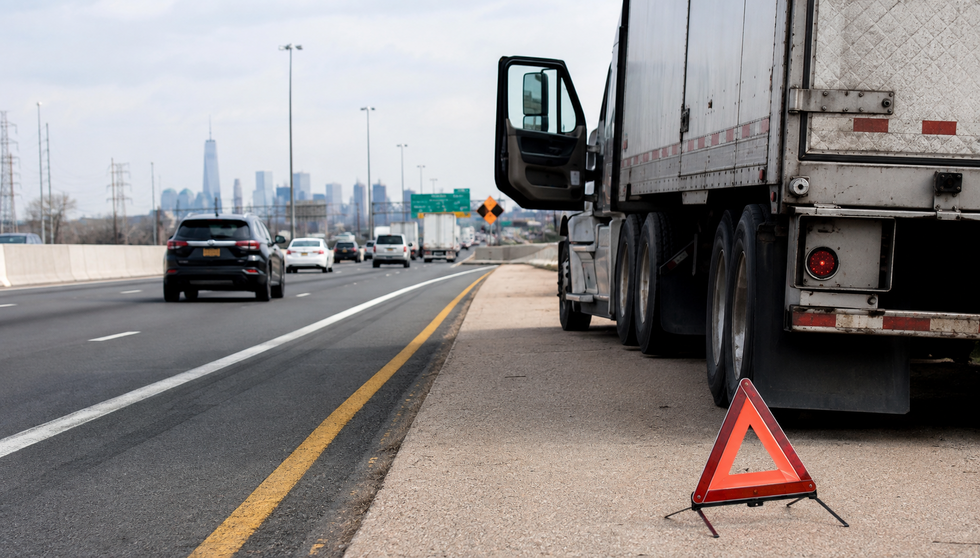
Who Is Liable When a Tractor-Trailer Hits a Disabled Vehicle in New Jersey?
There is no automatic answer.
The fact that one truck was traveling and another was disabled on the shoulder does not, by itself, establish exactly why the crash occurred or who may ultimately bear legal responsibility.
A New Jersey truck accident lawyer investigating this type of collision may need to determine why the moving tractor-trailer entered the shoulder in the first place.
Depending on the evidence, an investigation could examine:
- The tractor-trailer driver's actions before impact;
- Vehicle speed, braking and lane position;
- Whether another vehicle contributed to the sequence of events;
- The mechanical condition of both commercial vehicles;
- Where and how the disabled truck was positioned;
- Visibility and roadway conditions;
- What warnings were being used around the disabled commercial vehicle; and
- Whether applicable federal and state commercial vehicle safety requirements were followed.
These are potential investigative issues—not findings about the August 14 crash. The New Jersey State Police investigation remains ongoing.
A Disabled Commercial Truck Creates Additional Safety and Liability Questions
This accident presents an important issue that does not exist in every commercial truck accident in New Jersey: one of the tractor-trailers was already disabled.
Federal commercial vehicle regulations address what drivers generally must do when a commercial motor vehicle stops on the traveled portion or shoulder of a highway.
The Federal Motor Carrier Safety Administration's rules for stopped commercial motor vehicles generally require hazard warning flashers and specified warning measures for covered commercial vehicles stopped on a highway or shoulder, subject to applicable exceptions and current regulatory waivers.
Why does that matter in an accident investigation?
Because investigators may need to establish not only why an approaching truck entered the shoulder, but also what occurred after the other truck became disabled.
That could include determining how long the truck had been stopped, its position relative to traffic, what warning systems or devices were being used and whether the circumstances complied with the safety requirements applicable to that particular commercial vehicle.
Importantly, none of that means the disabled Peterbilt driver caused or contributed to this crash. Police have not publicly made such a finding.
It illustrates why liability should be based on evidence rather than assumptions.
Why Commercial Truck Accident Evidence Can Change the Case
One of the most important differences between a serious tractor-trailer collision and many ordinary passenger-car crashes is the potential amount of evidence available.
A NJ truck accident attorney may investigate information that goes far beyond the police report.
Depending on the vehicles and motor carriers involved, relevant evidence may include:
- Electronic logging and hours-of-service information;
- Electronic vehicle or engine data showing speed, braking or other operating information;
- GPS, fleet-management and dispatch records;
- Dashcam or other available video;
- Driver qualification and employment records; and
- Truck inspection, repair and maintenance records.
Some of this information may be controlled by the trucking company, another business or a third-party service provider rather than the injured person.
That makes identifying and preserving relevant evidence particularly important after a catastrophic tractor-trailer accident in New Jersey.
If you or a family member has been seriously injured in a collision involving a tractor-trailer, box truck, delivery truck or other commercial vehicle, Khorozian Law Group can investigate the circumstances and explain your legal options. Call(201) 944-9200 or contact us online to speak with a New Jersey truck accident attorney.
Can the Trucking Company Be Liable Even If Its Driver Was Behind the Wheel?
Potentially.
One of the biggest mistakes in evaluating a commercial truck accident is assuming the claim necessarily begins and ends with the individual driver.
Depending on the facts and relationships involved, a New Jersey truck accident claim may require investigating the motor carrier, employer, vehicle owner, contractor, maintenance provider or another company connected to the truck's operation.
Questions can include whether the driver was properly qualified, whether the vehicle was adequately inspected and maintained, whether applicable hours-of-service requirements were followed and whether company practices contributed to the circumstances surrounding the crash.
A trucking company is not automatically liable merely because its vehicle was involved in an accident. But identifying every person and business with a role in the vehicle's operation can be critical when determining responsibility and available insurance coverage.
What Happens When the Injured Person Was Outside the Disabled Truck?
The Secaucus crash also illustrates another potentially dangerous situation: a driver who has exited a disabled vehicle.
According to the reported facts, the Peterbilt driver was outside the truck when the collision occurred and sustained minor injuries.
A person does not automatically lose the right to pursue compensation simply because they were outside their vehicle when they were hit.
In another case, a driver, passenger, tow operator or other person injured outside a disabled vehicle may have a claim if another party's negligence caused the collision.
The specific circumstances still matter—including where the person was positioned, how the collision occurred and what each involved party did before impact.
For motorists involved in a New Jersey Turnpike accident, the distinction can become especially important because an initial vehicle breakdown can turn into a separate collision involving an approaching car or commercial truck.
Who Could Be Investigated After a New Jersey Commercial Truck Crash?
Commercial vehicle accidents can involve multiple individuals and companies.
Depending on the evidence, potential parties requiring investigation could include:
The truck driver. Driver conduct may be relevant if the evidence indicates that actions behind the wheel contributed to the collision.
The motor carrier or trucking company. Company practices involving drivers, safety, supervision or vehicle operation may become relevant depending on the circumstances.
The vehicle owner. The company owning the tractor or trailer may not always be the same entity employing or contracting with the driver.
A maintenance or repair provider. If evidence eventually identifies a mechanical problem, maintenance and repair records may become important.
Other motorists or entities. Some crashes involve a chain of events in which another vehicle or party contributes to the collision even without making direct contact.
This is why an experienced NJ personal injury lawyer handling a commercial vehicle case should investigate the relationships between the driver, vehicle, carrier and other businesses instead of assuming that only one insurance policy or defendant is involved.
Why the Secaucus and Hudson County Location Matters
The August 14 collision occurred near milepost 112.4 of the New Jersey Turnpike in Secaucus, Hudson County.
For someone injured in a serious collision in this area, the location can affect where the crash is investigated, where a lawsuit may potentially be filed and which evidence or witnesses may be relevant.
A Hudson County personal injury lawyer handling a serious commercial vehicle case may also need to coordinate evidence involving an out-of-state driver or trucking company while pursuing a claim arising from a New Jersey collision.
Commercial trucking is interstate by nature, so the driver, carrier, truck owner, insurer and injured person do not necessarily come from the same state.
What Should Be Investigated After a Serious NJ Truck Accident?
After emergency medical needs have been addressed, one of the most important legal questions is what evidence exists and who possesses it.
A truck accident investigation may include obtaining the police crash report, identifying witnesses, documenting the vehicles and collision scene, determining the motor carrier and vehicle ownership, investigating applicable commercial insurance coverage and seeking preservation of relevant electronic and company records.
This can be particularly important when a crash results in catastrophic injuries or death.
The purpose is not to assume that a trucking company or driver violated the law. It is to determine what happened using evidence that may provide information unavailable from the collision scene alone.
Frequently Asked Questions About NJ Truck Accidents
Who is liable when a tractor-trailer hits a disabled truck on the shoulder?
Liability depends on why the collision occurred. Investigators may examine why the moving truck entered the shoulder, the location and visibility of the disabled vehicle, applicable warning requirements, vehicle condition and the conduct of everyone involved. Being stopped on the shoulder does not automatically establish or eliminate liability.
Does a disabled commercial truck have to use warning devices?
Federal regulations generally impose warning requirements when covered commercial motor vehicles stop on the traveled portion or shoulder of a highway, although exceptions and regulatory waivers may apply. Determining what requirements applied to a particular vehicle at the time of a crash requires examining the specific circumstances.
Can a trucking company be responsible for a driver's accident in New Jersey?
Potentially. The answer depends on the driver's relationship with the company and the facts surrounding the collision. A commercial truck accident investigation may also examine company practices, vehicle maintenance, driver qualifications and other relevant evidence.
What evidence can a truck accident lawyer obtain?
Depending on what exists and is legally obtainable, evidence may include electronic vehicle data, ELD information, GPS and dispatch records, dashcam footage, inspection and maintenance records, driver records, photographs, surveillance footage, witness statements and police records.
Can someone hit while standing outside a disabled vehicle file an injury claim?
Potentially, yes. A person injured outside a disabled vehicle may have a personal injury claim when another party's negligence caused the collision. Liability depends on the circumstances surrounding the accident.
Are tractor-trailer accident claims different from ordinary car accident cases?
They can be. Commercial truck cases may involve federal safety regulations, trucking-company records, commercial insurance, electronic vehicle information and multiple businesses connected to the driver or vehicle. Those issues may not exist in a typical New Jersey car accident claim.
How long do I have to file a truck accident lawsuit in New Jersey?
New Jersey generally applies a two-year statute of limitations to personal injury lawsuits based on wrongful acts or negligence. However, particular circumstances can affect legal deadlines, and valuable evidence may disappear well before the filing deadline. An injured person should obtain advice based on the specific facts rather than relying solely on the general limitations period.
Injured in a Truck Accident in New Jersey?
The cause of the fatal August 14 tractor-trailer collision in Secaucus remains under investigation. What the crash demonstrates is why serious commercial vehicle cases can require a much broader investigation than simply determining where two vehicles collided.
Electronic records, vehicle condition, driver conduct, federal trucking requirements, company relationships and commercial insurance may all become relevant to determining what happened and who may be legally responsible.
If you or someone you love was injured in atruck accident, tractor-trailer accident, commercial vehicle accident or car accident in New Jersey, Khorozian Law Group can review the circumstances and help you understand your legal options.
Call Khorozian Law Group at (201) 944-9200 or contact us online to speak with a New Jersey personal injury attorney.
¿Usted o un ser querido resultó lesionado en un accidente de camión, tractor-tráiler o vehículo comercial en Nueva Jersey? Llame a Khorozian Law Group al (201) 944-9200 o contáctenos en línea para conocer sus opciones legales.
Comments
There are no comments for this post. Be the first and Add your Comment below.
Leave a Comment